
Suppose you organise a summer festival. You have made agreements with three artists, two food trucks, a sound company, a security company and five sponsors. For each of them: there is a contract, there are deadlines, there are invoices and there are tasks that follow from the agreements.
How do you keep the overview? Many organisers start with an Excel file. Or with a folder full of PDF contracts. Or, even more dangerous, with loose WhatsApp conversations and e-mail threads per supplier. Until something goes wrong.
The real cost of fragmented management
The problem with loose tools is not just that they are time-consuming. The problem is that they create risks you don't see coming:
- An artist expects a different technical rider than what you have in your notes. Because the latest version is in an e-mail, not in your system.
- A sponsor invoice only goes out two months after the event goes out, because the task "send invoice" got lost somewhere.
- A supplier calls on the day itself to say he has the wrong location, because the latest update was in a message nobody read anymore.
These kinds of incidents are not exceptional. They are the norm at organisations that don't manage their deals centrally. And every incident costs time, money and reputation.
What professional deal follow-up involves
A deal is more than a contract. It is a relationship with agreements, attachments, tasks, notes and invoices. Professional management means that all those elements are linked to each other, and that everyone in your team has access to the right information at the right moment.
1. All agreements in one place
Every deal has its own file, whether it's an artist, a sponsor or a supplier. In it you find the contract, the attachments, the contact details and the full communication history. No more searching through mailboxes.
2. Tasks that follow automatically from agreements
The most forgotten agreements are the tasks that are in the contract, but never ended up in a task list. Clubwise with AI task creation analyses the deal content and automatically generates a task list: "Send contract for signature", "Receive logo for website & print", "Deliver impact report after event".

Practical example: at Lier Centraal VZW all supplier deals run through Clubwise. After a deal is created, AI automatically generates the follow-up tasks based on the contract content. The team no longer needs a separate task list, because everything is in the system.
3. Invoicing linked to the deal
Deal completed? Then you create an invoice and all details (amount, VAT number, contact person) are taken over from the deal. For sponsor deals you can even record a multi-year invoicing plan, with a partial invoice per season automatically. No more copy-paste, no more forgotten invoices.

4. Notes as internal follow-up
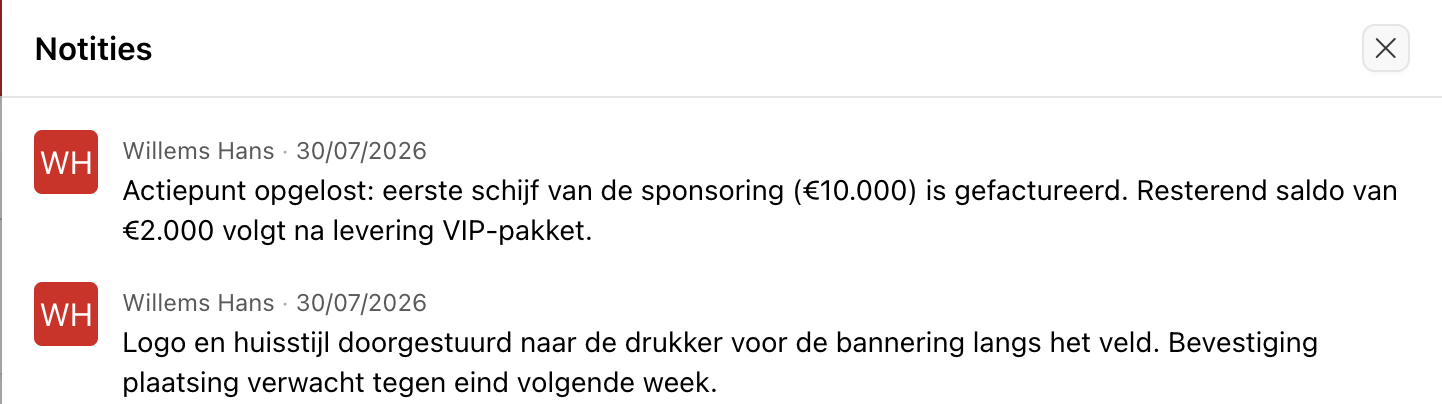
Every deal has a notes field that works as an internal chat. You record agreements made by phone, add action points and mark what has been solved. Your colleagues see the same timeline. Nobody has to ask "how was that again?" anymore.
Looking at sponsors differently
Sponsors are not just paying parties, but partners with expectations. They expect considerations: a banner, a mention on social media, an activation moment. If you don't follow up those considerations systematically, you risk a frustrated sponsor who won't join next year.
A good deal follow-up tool shows you per sponsor: what was agreed, what has already been delivered, what is still open, and when the contract expires. That also makes the conversation about renewals much easier: you have the facts on the table. Read more about that in How to keep sponsors with your club longer with measurable ROI.
The five steps to structured deal follow-up
- Centralise everything: stop with e-mails and folders, use one system per deal.
- Link documents to deals: contracts, riders, attachments belong to the deal, not to a loose contact.
- Make tasks explicit: every agreement that requires action becomes a task with an owner and a deadline.
- Synchronise invoicing: let your deals generate invoices automatically at the right moments.
- Review after every event: which deals went perfectly? Which didn't? Record that in the system as input for next year.
Conclusion
Managing deals with artists, suppliers and sponsors is not a side issue. It is the backbone of a well-organised event. Organisations that centralise this save hours per event, avoid costly mistakes and build stronger relationships with their partners.
The good news: you don't need to learn complex software for this. You need a tool that works the way you think: with files per deal, smart task creation and a direct link to invoicing. That's exactly what the Clubwise Deals module module was built for.
Ready to follow up your deals professionally?
Request a free demo and discover how Clubwise transforms your contract management.
Request a free demo →